Case study overview
From public property discovery to secure, role-specific operational workflows - one connected product designed for the way a local property business works.
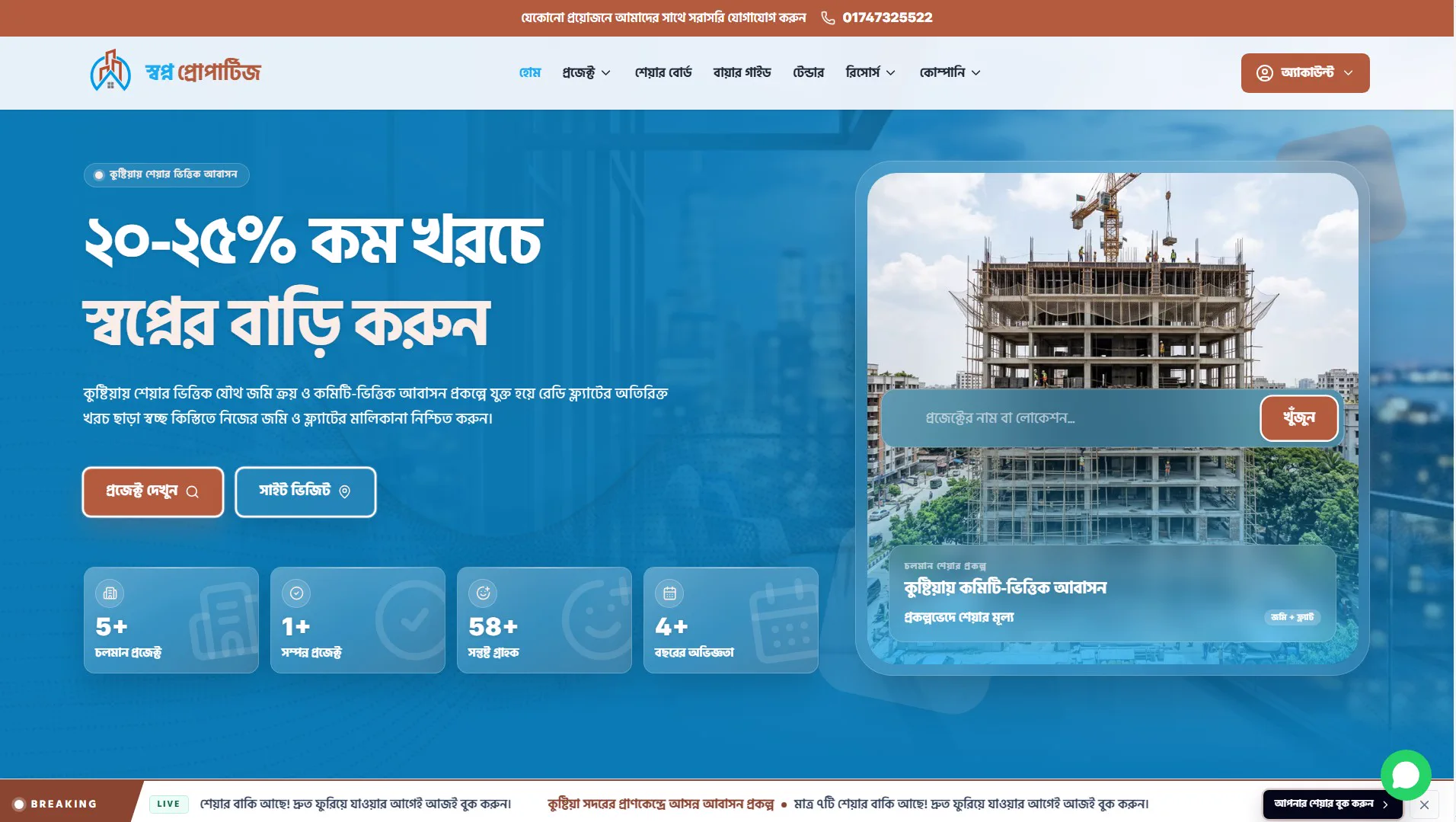
A Real Estate Website Was Only the Beginning
Shopno Properties is a buyer-focused property developer in Kushtia, Bangladesh. Its model is built around share-based joint land purchase and housing development: buyers participate in a project, follow legal and construction stages, pay in planned instalments and remain involved through completion and handover.
That model creates a different digital challenge from a conventional property-listing website. The company does not simply publish flats and collect enquiries. It coordinates a long chain of people, money, documents, approvals and construction decisions. Every project can involve prospective buyers, confirmed shareholders, sales staff, project managers, accountants, brokers, contractors, inspectors and buyer committees.
GMK Solution's task was to turn that operational complexity into a clear, trustworthy digital experience.
The result is Shopno Properties: a custom real estate operations platform that connects public property discovery with the work happening behind each project. This real estate platform development case study shows how we combined a conversion-focused marketing website with CRM, buyer servicing, share management, finance, procurement, contractor coordination, inspection, reporting and content publishing.
The Business Challenge
Property development creates information over months and years. A lead becomes a buyer. A buyer receives a share. That share carries a payment plan and private documents. The project passes through legal stages, tender decisions, construction milestones, inspections and warranty obligations. If those records live in separate spreadsheets, chat threads, paper files and standalone tools, teams lose context and buyers lose confidence.
Shopno Properties needed to solve five connected problems.
1. Make a Local Housing Model Easy to Understand
Share-based housing is unfamiliar to many first-time buyers. Visitors needed to understand the project model, compare project stages, see available shares, estimate costs and review the steps between land selection and handover—without decoding internal real estate terminology.
2. Create Transparency Throughout the Buyer Journey
Buyers needed a secure place to see their allocated share, instalment history, payment receipts, legal documents, construction updates, notices and project decisions. The experience had to feel clear on a mobile phone and natural for Bengali-speaking users.
3. Give Every Team the Right Operational View
A sales manager should see leads and follow-ups. An accountant should see collections, expenses and reconciliation. A construction manager should see tenders, contracts and milestones. Giving everyone one unrestricted dashboard would be both confusing and unsafe.
4. Connect Procurement to Construction Accountability
Tendering could not end when a contractor submitted a price. The platform needed to support quotation comparison, owner voting, contract creation, work evidence, payment milestones, independent inspection, warranty claims and contractor ratings.
5. Build for Search, Growth and Daily Administration
The public website needed strong local-search foundations, while internal teams needed to publish projects, articles, FAQs, video tours, announcements and testimonials without developer assistance. Marketing attribution and follow-up channels also had to connect to the lead journey.
Our Product Strategy
We approached the project as a digital operating system, not a brochure website.
The first architectural decision was to create a shared source of truth. Projects, shares, leads, buyers, payments, documents, tenders, quotations, contracts and construction records all live in one relational PostgreSQL system. That prevents the public site and private dashboards from presenting different versions of the same project.
The second decision was to model the product around real user journeys. Instead of forcing every user into a generic admin interface, we created purpose-built experiences for buyers, brokers, contractors, inspectors and five levels of internal administration. Permissions, dashboards, navigation and actions change according to the user's responsibilities.
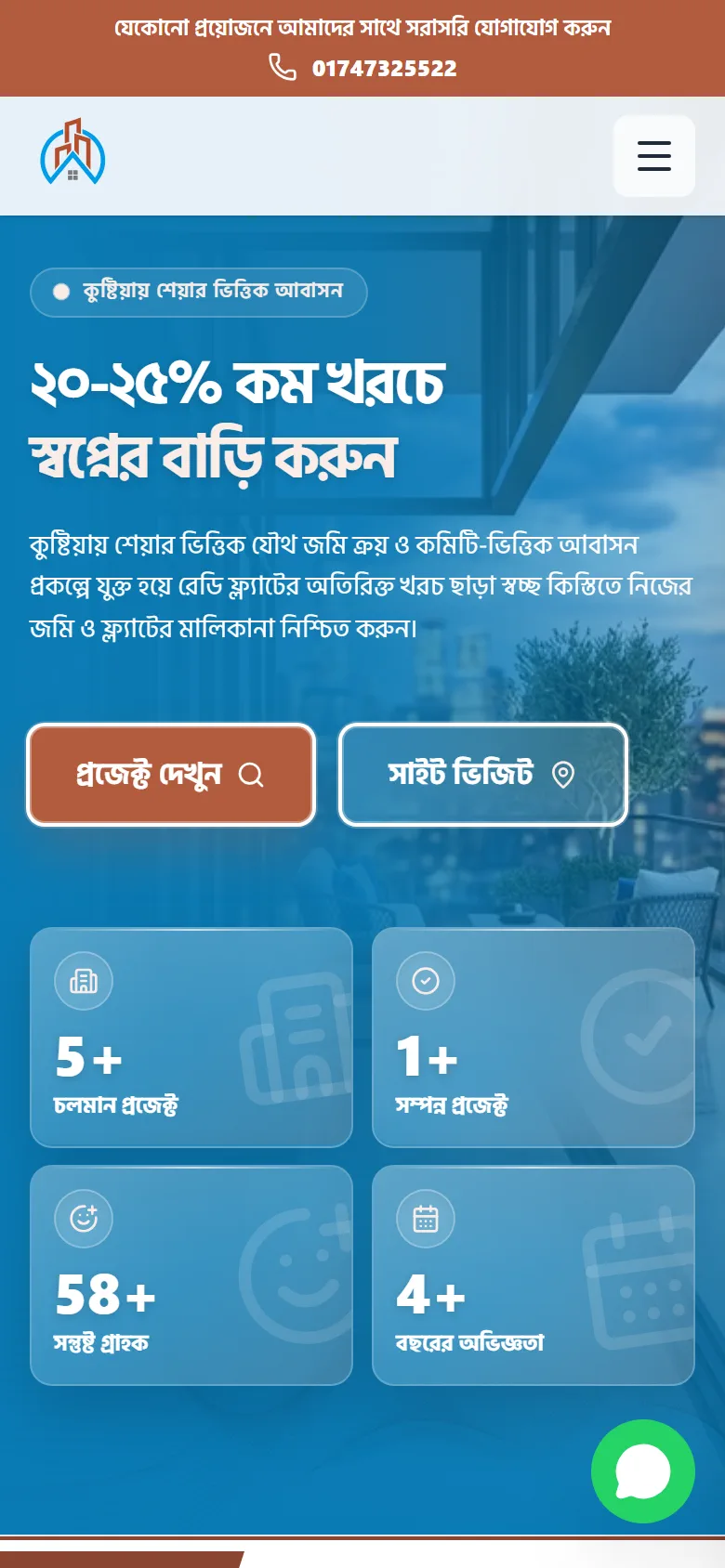
The third decision was to design for the local context from the beginning. Bengali is the primary interface language. Currency, dates, phone validation, WhatsApp communication, map behaviour and mobile layouts reflect how the target audience actually searches, communicates and makes property decisions in Bangladesh.
This combination of shared data, role-specific workflows and local UX became the foundation for the full platform.
Platform Scale at a Glance
The delivered application contains 164 routed page modules. Twenty-one power the public website and property-discovery journey, while 13 support authentication, registration, verification and account onboarding. Another 129 pages sit inside role-protected portals, with 81 administration pages, 20 buyer pages, 12 contractor pages, 11 broker pages and 5 inspector pages; one shared dashboard route directs authenticated users to the correct workspace. Across those protected experiences, the product exposes 67 primary workflow destinations, including 35 core administration modules. Behind the interface are 351 reusable TSX components, 99 server-action modules, 30 API route handlers and 75 connected database models. These counts show the true scope more clearly than a conventional “website page” total: Shopno Properties is a multi-role business application with a public acquisition layer.
What GMK Solution Delivered
The engagement produced three connected layers. The first is a public growth platform for project discovery, local SEO, educational content, enquiries and site visits. The second is a set of protected workspaces for buyers, brokers, contractors, inspectors and internal teams. The third is an operational backbone for identity, permissions, CRM, shares, money, documents, procurement, construction, communication, reporting and system administration.
We also delivered the supporting product infrastructure: a reusable design system, Bengali-responsive layouts, content-management tools, secure media storage, transactional communication, analytics, scheduled automation, export and backup utilities, role guides, automated policy checks, deployment configuration and CI verification. This matters because the client received an operable product and maintenance foundation, not only front-end screens.
How We Structured the Delivery
The work was organized around complete business journeys rather than isolated pages. Requirements were translated into lifecycle states, ownership rules and a permission matrix. Shared identity, design, database and validation foundations came first; complete vertical workflows—such as enquiry to buyer, tender to contract and milestone to inspected payment—were then built across the relevant portals.
The final phase focused on production hardening: responsive behaviour at mobile widths, role and multi-portal access, private-file policies, session revocation, notification reliability, map performance, reporting, system health and repeatable QA. That phased approach reduced the risk of building attractive interfaces that did not agree with one another operationally.
The Solution
1. Public Property Discovery That Builds Confidence
Public experience
A Bengali-first property-discovery experience built to make the share-based housing model clear from the first visit.
The public experience introduces Shopno Properties and helps a visitor move from curiosity to a meaningful enquiry.
Visitors can explore running, upcoming, completed and sold-out developments; filter the project catalogue; search by project; and open detailed project pages. Each project can present its location, land area, building configuration, estimated handover, price components, payment plan, legal status, construction progress, gallery, FAQs and related projects.
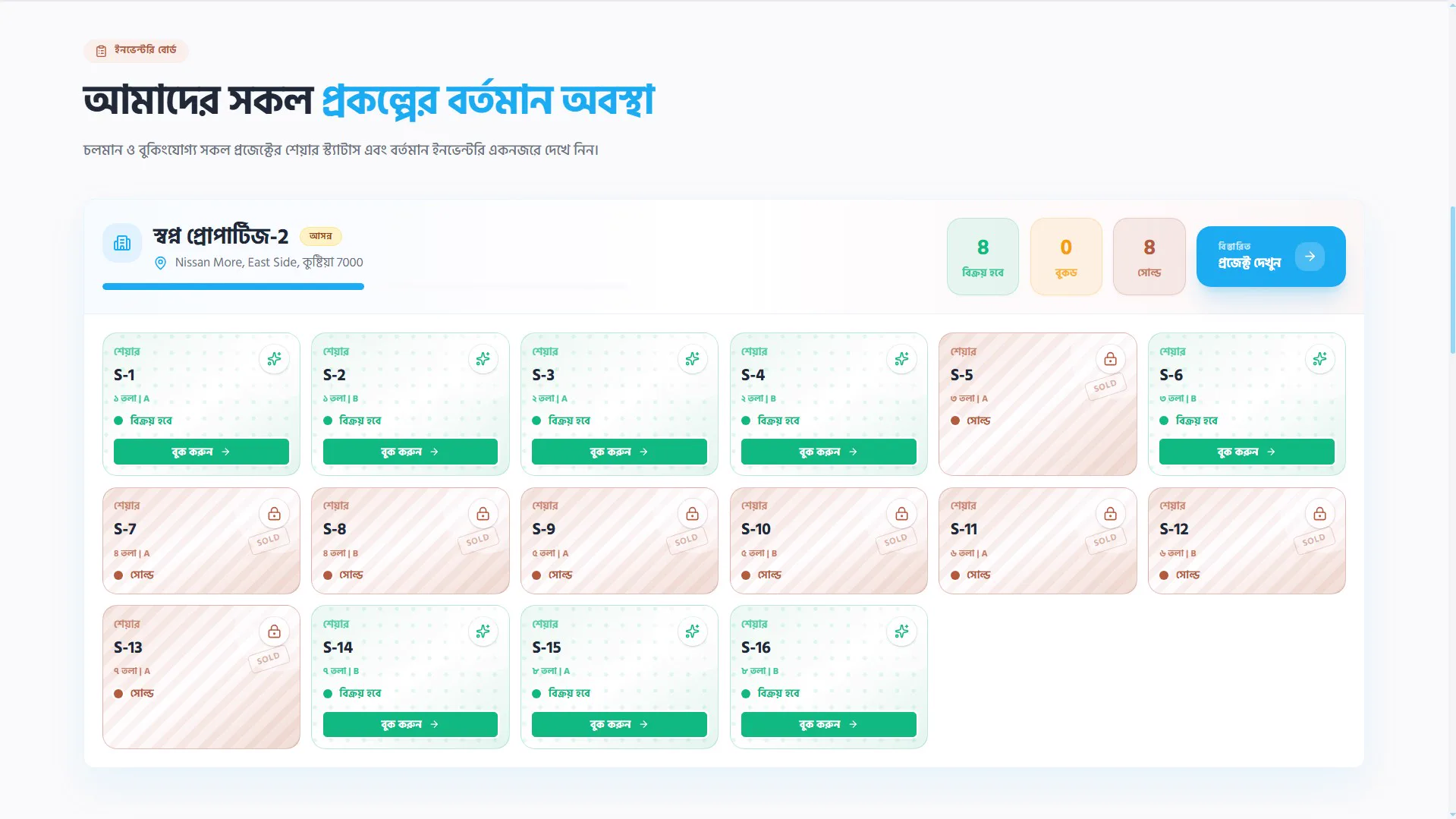
The availability board makes the share-based model tangible. Instead of a vague “contact for availability” message, a project can show which shares are available, booked, sold or cancelled. Upcoming projects can collect waiting-list interest, while active projects can accept demand enquiries and site-visit bookings.
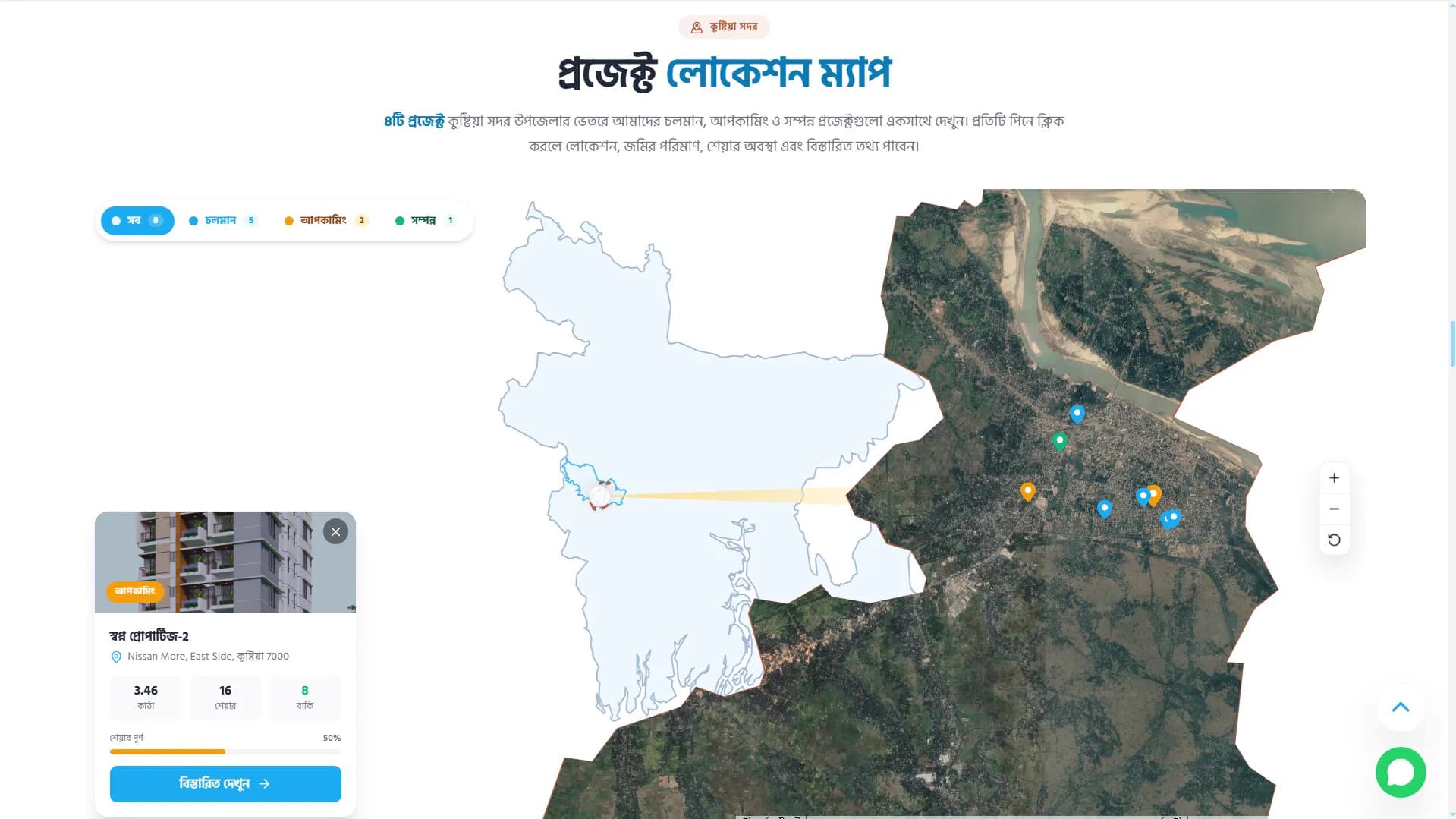
A custom Kushtia map brings every published development into one location-aware view. It combines project pins, status filters, a detailed Kushtia boundary, road context and satellite imagery. Individual project pages also show nearby landmarks and Google Maps directions, helping buyers judge a site by real-world context rather than marketing copy alone.
The public journey also includes a cost calculator, buyer guide, photo gallery, video tours, buyer stories, FAQs, a blog and contact options. WhatsApp actions remain visible throughout the experience because that channel is central to local sales conversations.
2. An Integrated CRM From Enquiry to Buyer Conversion
Every serious property enquiry needs follow-up. We built an internal CRM that brings website leads, broker referrals, phone enquiries, site visits and manually entered prospects into one pipeline.
Sales staff can manage leads through stages such as new, contacted, site visit scheduled, interested, negotiation, booking confirmed, converted and lost. They can record notes, activities, source attribution, interest level, budget, follow-up dates and lead scores. A Kanban view makes pipeline movement visible, while detailed timelines preserve the history of each relationship.
When a prospect is ready, an authorized user can convert the lead into a buyer, connect the buyer to a project share and begin the formal payment and document lifecycle. Broker attribution remains attached, allowing the platform to create and track commissions rather than losing the referral when the lead changes status.
This is where the value of one data model becomes visible: the sales record does not end at conversion. It becomes the starting point for buyer service, payment collection and project participation.
3. A Buyer Portal Designed Around Transparency
The buyer portal gives each customer a private, role-verified view of their relationship with Shopno Properties.
Buyers can review their allocated share and project details, follow legal and construction progress, access notices, view secure documents, track instalments, submit payment proof and download branded receipts. They can also manage their profile, notification preferences, phone verification and active device sessions.
Transparency continues beyond read-only updates. Buyers can message the administration team, participate in project-specific tender reviews, view active construction contracts, submit referrals and raise warranty claims with photographic evidence. These workflows convert “buyer participation” from a promise into a usable product feature.
The portal is intentionally mobile-first. Dense tables collapse into readable cards or controlled horizontal views, long Bengali content wraps safely and primary actions remain reachable on smaller screens. This work was especially important because payment records, document names and communication history can easily break conventional dashboard layouts.
4. Role-Specific Administration Instead of One Overloaded Dashboard
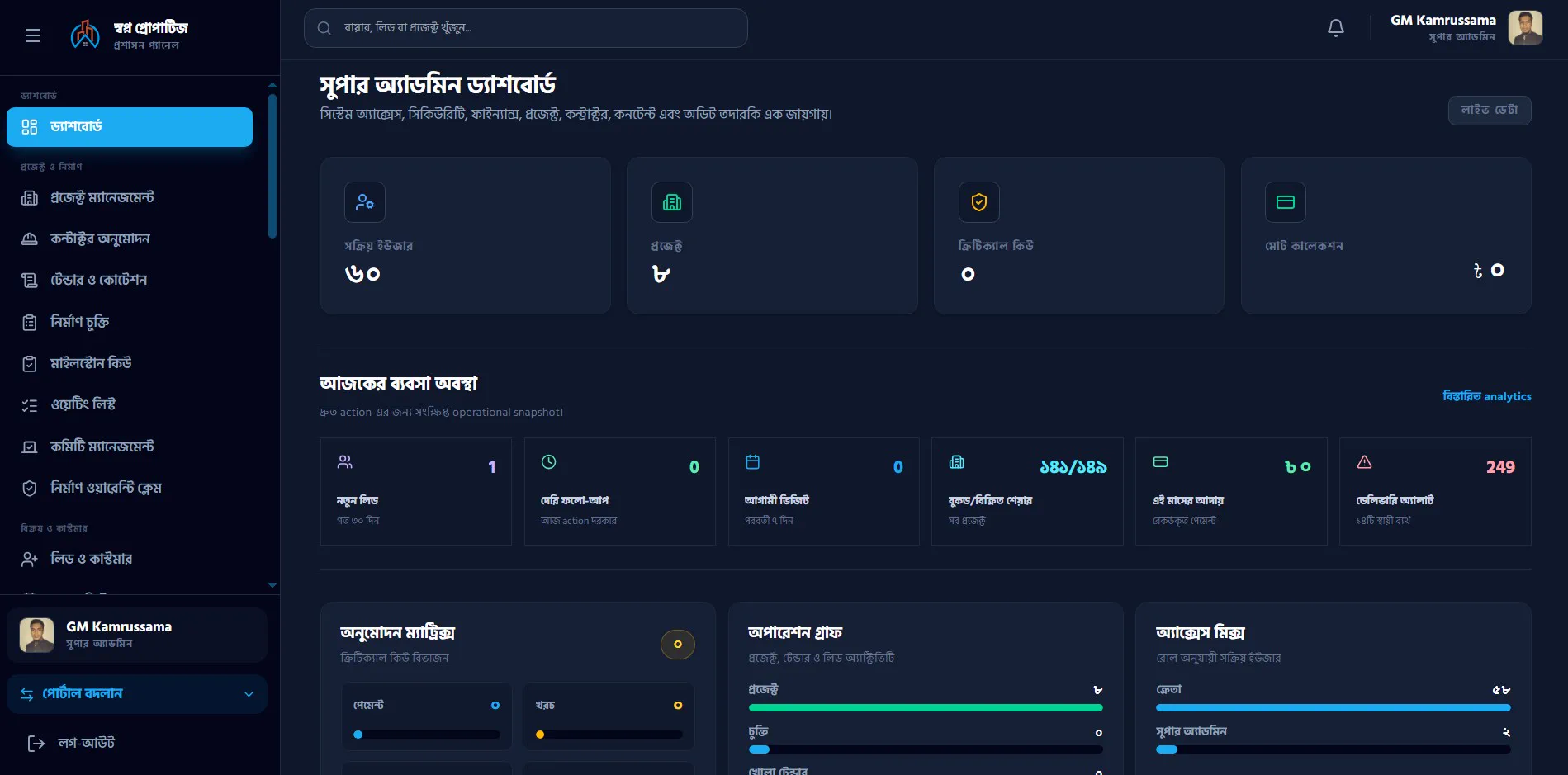
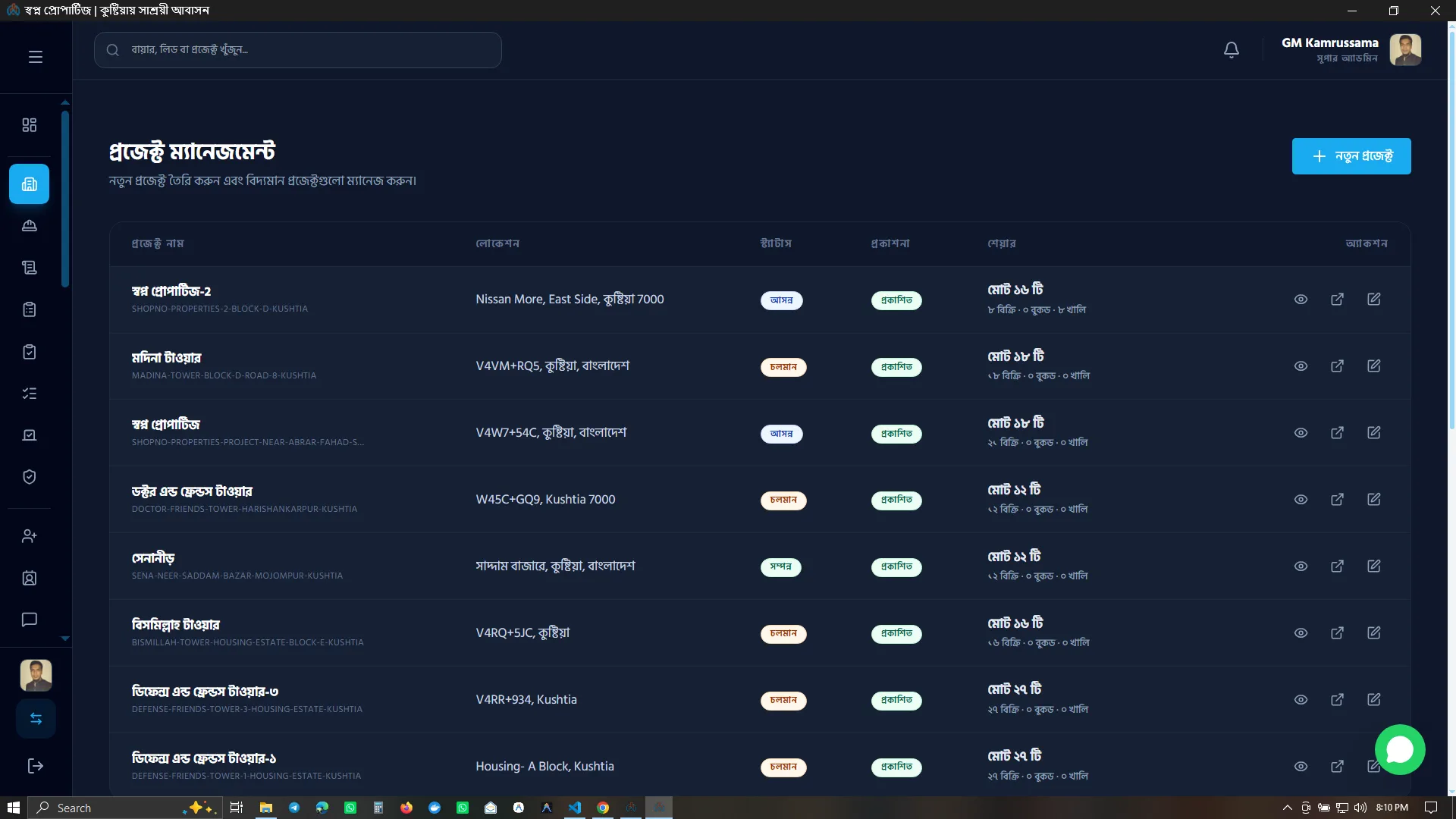
Role-specific workspaces
A focused operational view for the people responsible for daily project decisions.
The administrative system supports Super Admin, Project Manager, Sales Manager, Accountant and Construction Manager responsibilities. Each role receives a dashboard, navigation and actions matched to its job.
- Super Admin receives organization-wide oversight, user access control, security, settings, system health, audit logs and operational modules.
- Project Managers focus on projects, shares, buyers, documents, committees, tenders, contracts, reports and project communication.
- Sales Managers focus on leads, waiting lists, buyers, brokers, payments, campaigns, content and conversion analytics.
- Accountants work with payments, expenses, petty cash, bank reconciliation, annual reports, tax records and financial reporting.
- Construction Managers manage tenders, contracts, milestones, inspections, construction updates and warranty work.
Dashboards show real database metrics rather than decorative placeholders. The platform also supports additive administrative access, so an existing buyer, broker, contractor or inspector account can receive an internal responsibility without requiring a duplicate identity.
That identity design matters in a real property business, where the same person may participate in more than one capacity over the life of a project.
5. Procurement, Contractor and Inspection Workflows in One Chain
Construction procurement is one of the platform's deepest workflows.
Contractors can register, submit identity and trade documents, provide business photographs, add team members, share video proof, list previous projects and select specialties. Administrators review each profile before approving, suspending or blacklisting access.
Approved contractors can browse relevant tenders and submit itemized quotations with material prices, quantities, brands, schedules, advance requirements and supporting documents. The system calculates comparison scores using price, contractor rating and experience signals. Project owners can review quotations and vote, while authorized managers retain the controls needed to shortlist, counter, approve or reject offers.
An awarded quotation becomes a construction contract with dates, value, advance payment, milestones and warranty terms. Contractors can then submit daily work logs, progress photos, materials used and milestone payment demands.
Payment approval is connected to evidence. A manager assigns an inspector to a milestone; the inspector receives the task in a dedicated portal, completes a checklist, uploads site photographs and records a pass, fail or conditional verdict. The resulting inspection report becomes part of the milestone record before the workflow advances.
After completion, warranty dates, claims, resolution evidence and contractor ratings remain connected to the original contract. This creates an accountable chain from tender publication to post-construction support.
6. Finance and Document Operations Built Into the Platform
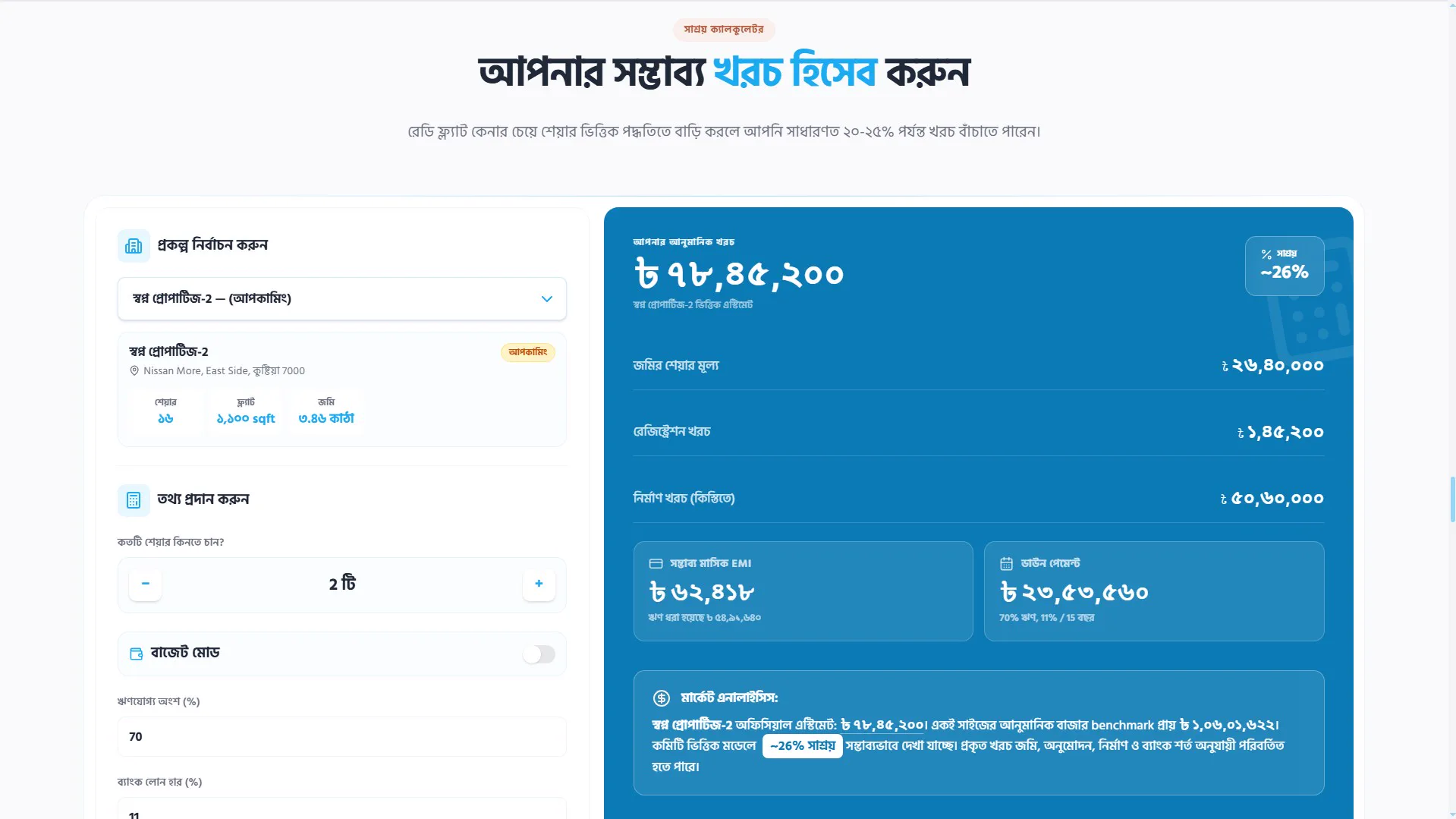
Buyer planning tools
A practical public tool that helps turn property interest into a more informed conversation.
The finance layer connects buyer collections and project expenditure without pretending to be a generic accounting package.
Authorized teams can create instalment schedules, record manual payments, review buyer-submitted proof, verify transactions and issue branded receipts. Expense workflows support categories, receipts, approvals and project attribution. Dedicated modules cover petty cash, annual financial reporting, bank-statement reconciliation and tax records.
Sensitive files are not treated like public website assets. Buyer documents, NID images, payment proof, contracts, tax receipts and inspection evidence are stored under purpose-specific upload policies. Private downloads are delivered through short-lived signed access after the application verifies the requesting user and associated database record.
This protects confidential property and identity records while keeping them usable for the people who need them.
7. Communication, Content and Marketing Operations
The platform turns common follow-up tasks into structured workflows.
Site-visit requests can trigger visitor confirmation, internal alerts, WhatsApp messages and lead tracking. Teams can send announcements and project-specific notices, manage broadcast campaigns and respect per-user notification preferences across dashboard, WhatsApp and email channels. Scheduled tasks handle reminders, tender deadlines, campaign delivery, warranty checks and system-alert digests.
Content teams can manage projects, blog posts, FAQs, home-page stories, video tours, galleries, testimonials, team profiles and announcement banners. This allows the public site to change with the business rather than waiting for code deployments for routine publishing.
Google Tag Manager, GA4 reporting, Meta event tracking and Conversions API support provide the measurement layer. Lead and visit actions can be attributed, while an internal analytics view brings key traffic signals into the administration portal.
Technical Architecture
We selected a modern full-stack architecture that could serve indexable marketing pages and secure, data-heavy portals in the same application.
The product is built with Next.js development, React 19 and TypeScript. Server Components handle data-rich views close to the database, while Server Actions keep authenticated mutations near the UI that invokes them. Select public content uses caching and revalidation, while personalized portals remain dynamic.
PostgreSQL and Prisma provide the relational core. The schema contains 73 models covering identity, projects, shares, CRM, buyer records, payments, documents, procurement, construction, messaging, finance and system operations. Transactions and database constraints protect critical changes such as share allocation, lead conversion and unique payment instalments.
Cloudflare R2 stores project media and operational files. Resend handles transactional email. Evolution API supports WhatsApp messaging. Leaflet, ArcGIS satellite tiles and Google Maps power location experiences. Vercel schedules operational cron routes, while a standalone Docker build provides a second production deployment path.
This modular architecture gives Shopno Properties a maintainable platform that can expand by workflow without splitting data across unrelated systems.
Key Engineering Problems We Solved
One Person, One Identity, Multiple Responsibilities
Property businesses often know a buyer by phone before that buyer creates an online account. The platform therefore supports account claiming and safe identity linking rather than blindly creating a second user. Email/password, Google and verified WhatsApp-phone journeys converge on one identity, with guarded rules preventing staff or partner accounts from being merged automatically.
The same identity can legitimately hold more than one relationship with the company. A broker may also purchase a share; a contractor may receive administrative access; an inspector may have another portal profile. Profile-backed portal access and an in-product portal switcher allow those responsibilities to coexist, while every protected action still verifies the effective role against current database records.
Consistent Financial and Lifecycle State
Projects, shares, buyers, payments, quotations, contracts and milestones cannot safely behave like unrelated content entries. We used relational constraints, transactional updates and explicit status models to preserve the connections between them. Monetary values are stored as integer-scale values rather than browser floating-point calculations, while unique constraints protect records such as buyer-share instalments, transaction identifiers and contractor quotations.
This makes critical transitions traceable: a lead conversion can allocate a share and preserve broker attribution; a verified payment updates the buyer ledger; an awarded quotation becomes a contract; and a milestone payment request remains connected to inspection evidence and approval state.
Bengali Documents and Usable Business Data
Operational software must let teams take information out as safely as they put it in. Shopno Properties includes branded payment receipts, bulk document downloads, database backup and management exports in CSV, formatted Excel and PDF formats. Bengali-aware font handling and UTF-8 output prevent names, project labels and financial records from becoming unreadable boxes or corrupted text in exported files.
Location Detail Without Sacrificing Performance
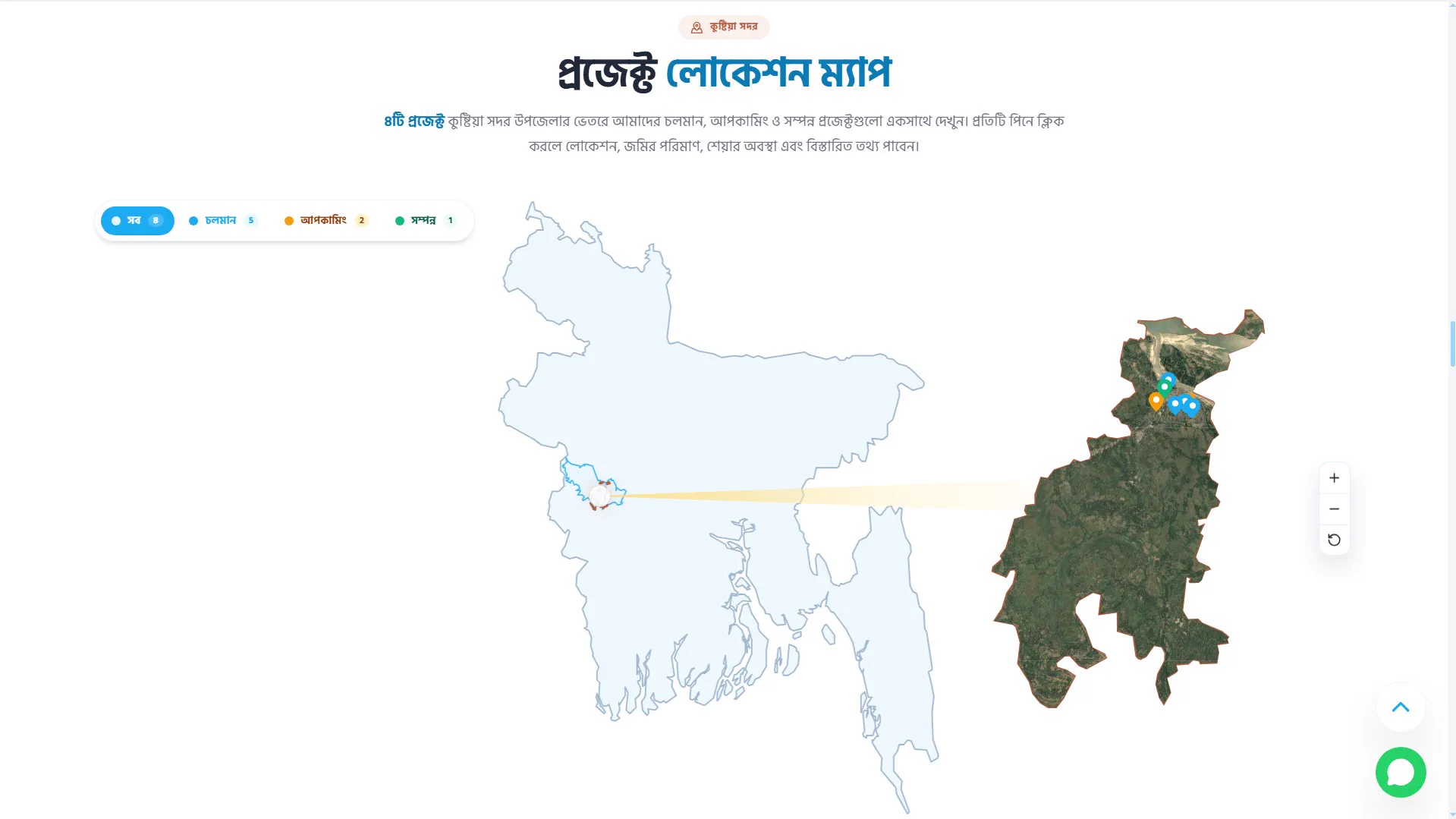
Location experience
Project locations, local context and map exploration are designed to stay practical on mobile.
The map experience combines a custom Kushtia boundary, project status filters, roads, satellite imagery and project detail. To keep that amount of geographic information practical on mobile, the implementation loads map code separately, limits satellite work to the active viewport, reuses loaded imagery and provides a fallback mapping path. Administrators can manage map-provider behaviour without changing page code.
Security and Trust Engineering
Real estate platforms hold identity documents, financial records and contractual information. Security therefore had to exist at the workflow level, not only at the login screen.
The platform combines credential login, Google sign-in and verified WhatsApp phone identity. Passwords are hashed, login attempts are rate-limited and Super Admin access is protected by a second verification step. Database-backed device sessions allow users to review and revoke active logins, while role changes and session versions invalidate stale authorization state.
Role checks are enforced again inside protected actions, not left to hidden menu items. Additive admin access is re-read from the database so a revoked permission cannot survive inside an older session token. Audit records capture important changes, and security headers reduce browser-level exposure.
Uploads use an explicit allowlist by folder, file type and role. Private documents require record-level authorization and signed delivery. Input validation, HTML sanitization, anti-spam constraints and durable rate limits protect public and authenticated entry points.
The result is a permission system aligned with the product's real-world responsibilities.
Bengali-First, Mobile-First Product Design
Localization was more than translating button labels.
The interface uses a Bengali-optimized type system, local number and date formatting, Bangladeshi phone rules and language that reflects the client's actual sales and construction process. Dense operational terminology is supported by in-product guides for buyers, brokers, contractors, inspectors and internal management roles.
Responsive behaviour was tested across the complex parts of the product: tables, cards, filters, quotation comparisons, finance records, messaging, project forms and dashboards. Reusable components, shared design tokens and consistent portal shells keep the experience coherent even though different users see very different tools.
Accessibility foundations include semantic page structure, a skip-to-content link, visible keyboard focus states, labelled navigation and responsive controls sized for touch interaction. These details are especially important in a platform where buyers and field users may rely on a phone rather than a desktop computer.
The result feels like one Shopno Properties product, not a public website with several unrelated admin templates attached.
Performance and Offline Resilience
The platform uses Server Components, parallel data loading, selective revalidation, route-level loading states, responsive image sizes, AVIF/WebP delivery and asset caching to balance fresh operational data with fast public pages. Heavy map functionality is loaded only where needed, and public home-page sections can stream independently instead of blocking the whole page.
Shopno Properties is also installable as a Progressive Web App. Its service worker caches public pages and static assets, discovers indexable project and blog URLs from the sitemap and provides an offline fallback when the network is unavailable. Protected pages use a separate cache, which is cleared when a user signs out so convenience does not override privacy.
SEO and Discoverability
The public platform was built around local intent such as housing projects, flats, land shares and property investment in Kushtia.
Our technical SEO implementation includes dynamic page metadata, canonical URLs, Open Graph and social previews, a database-driven XML sitemap, robots rules and index protection for private portals. Structured data covers the organization, breadcrumbs, real estate listings, blog articles and relevant FAQ content.
Project pages generate unique titles, descriptions, availability information and social images from live project data. The blog CMS supports custom metadata, categories and tags, giving the team a practical route to publish locally relevant search content. Responsive image sizing, modern AVIF/WebP formats, font optimization, lazy loading and sensible caching support search performance and usability together.
The measurement setup connects this foundation to analytics implementation, allowing the team to review acquisition and conversion activity instead of treating SEO as a one-time launch task.
Quality Assurance
The platform was tested at both interface and policy levels.
Role-by-role QA covered the main admin, project management, sales, accounting, construction, buyer, broker, contractor and inspector journeys. Automated validation checks core feature rules, contractor input, inspection reports, upload permissions, private-file delivery and action-level authorization.
At the time of this case-study review:
- TypeScript validation completed without errors.
- The complete ESLint scan completed without errors.
- The Prisma schema passed validation.
- All 10 targeted feature and validation checks passed.
- All 15 upload-policy checks passed.
- All 6 private-file access checks passed.
- A static authorization scan confirmed centralized guards across 80 protected action and sensitive API files.
This evidence gives the delivery team a repeatable baseline as the platform continues to evolve.
Operational Readiness and Handover
Production readiness extends beyond feature QA. The repository includes a CI workflow that installs dependencies, generates the database client, runs TypeScript and ESLint checks, verifies route documentation, tests upload and file-access policies, scans protected actions for authorization guards, validates the Prisma schema and audits dependencies.
In production, system-health tools check the database, object storage and authentication layer. Critical failures can be written to the audit trail and sent to the Super Admin through WhatsApp. Scheduled jobs handle campaign delivery, reminders, tender deadlines, warranty checks and system-alert digests, while notification logs preserve send status and errors for follow-up.
Authorized administrators can create full data backups and export operational or financial information for offline review. Vercel configuration supports scheduled cloud execution, while the standalone Docker and PostgreSQL setup provides a portable deployment path. Together with in-product role guides, these capabilities make ongoing operation and handover substantially more practical.
The Operating Change
The original product challenge was fragmentation: public information, sales follow-up, buyer service, financial records and construction accountability could easily become separate processes with different owners and different versions of the truth. The delivered platform changes that shape. A public enquiry can become a scheduled visit, a managed lead, a verified buyer, an allocated share and a continuing payment and project relationship without losing its history.
The same continuity applies after the sale. A tender can move through contractor quotation, owner review, contract, work evidence, inspection, milestone payment and warranty while remaining attached to the correct project. This connected lifecycle is the central business outcome of the work: fewer disconnected records, clearer responsibility at each stage and a stronger foundation for future performance reporting.
The Results
Shopno Properties now has one connected platform for the full relationship between a housing project and its stakeholders.
A Single Source of Operational Truth
Project status, share availability, buyer ownership, payments, legal progress, procurement and construction evidence are connected instead of being maintained in separate tools.
A More Transparent Buyer Experience
Buyers can independently review the information that matters after booking: ownership, instalments, receipts, documents, construction updates, notices, tenders and warranty activity.
Clear Accountability Across Construction
Tender comparisons, owner participation, contracts, milestone evidence, inspector reports and warranty records create a traceable path from procurement to completion.
Focused Workspaces for Every Role
Sales, finance, project and construction teams can work from purpose-built dashboards, while brokers, contractors and inspectors receive dedicated portals for their part of the process.
A Search-Ready Growth Platform
The company can publish projects and educational content, capture enquiries, schedule visits, attribute leads and measure digital activity without separating marketing from operations.
Delivery at Platform Scale
The completed application combines 21 public pages with 129 role-protected portal pages and 13 authentication and onboarding pages. The private application is distributed according to responsibility—81 administration pages, 20 buyer pages, 12 contractor pages, 11 broker pages and 5 inspector pages—while shared components, server actions, APIs and one relational data model keep those experiences synchronized. Those numbers matter because they represent one coordinated system, not a collection of disconnected microsites.
Final Takeaway
The most important outcome was not the number of dashboards or features. It was turning a trust-dependent property process into a product people can understand and teams can operate.
Shopno Properties demonstrates how thoughtful custom software development can fit the realities of a local business: Bengali communication, mobile-first customers, WhatsApp follow-up, role overlap, buyer participation and a construction lifecycle that continues long after the initial sale.
GMK Solution delivered the public experience, operational backbone and technical foundation as one platform—giving Shopno Properties a stronger way to market projects, serve buyers and manage accountable growth.
Platform in practice
Built for buyers, teams and daily operations
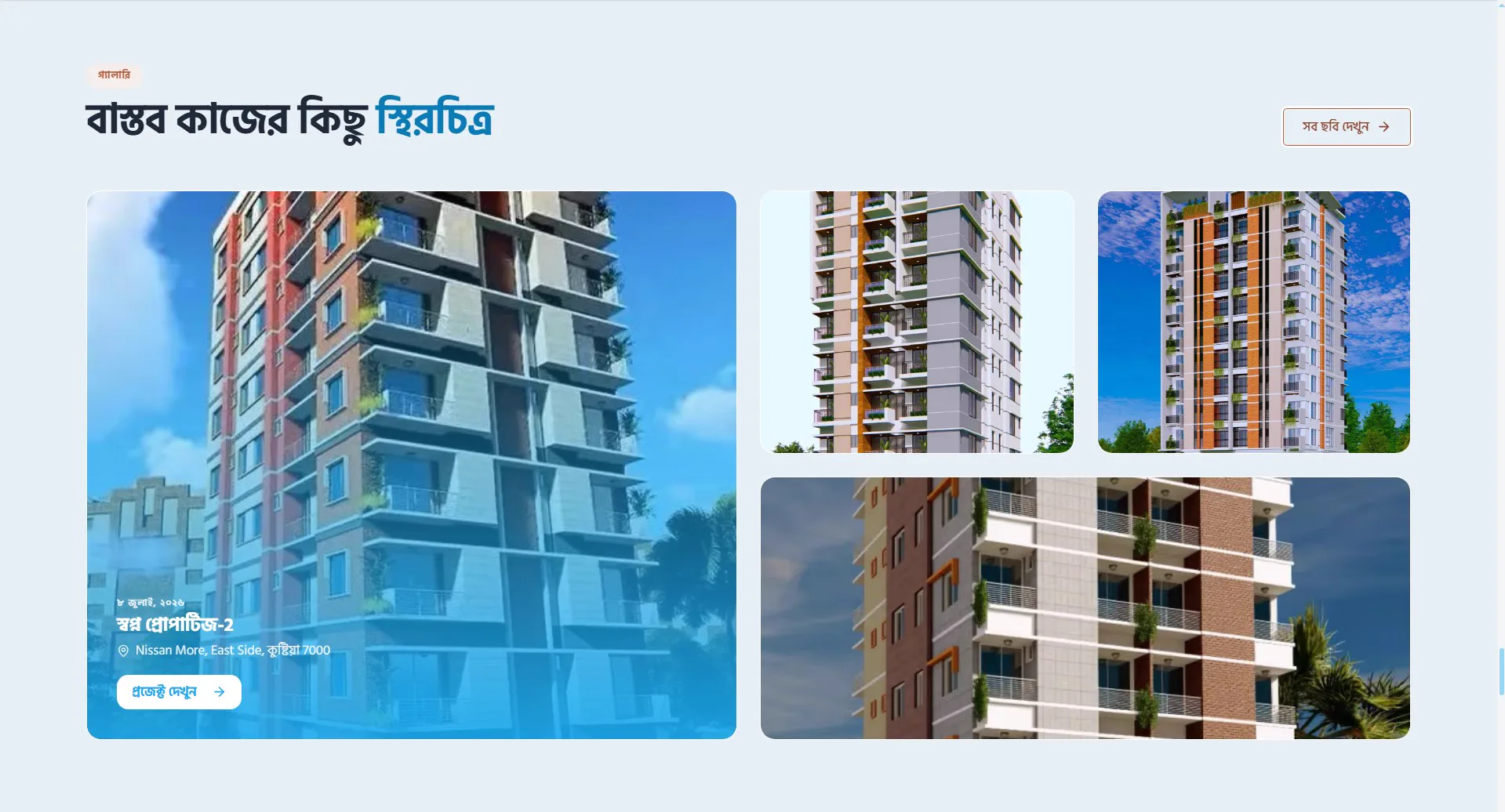
A selection of the public discovery experience and the protected operational workspaces delivered for Shopno Properties.
Call to Action
Need More Than a Real Estate Website?
If your property business is still managing leads, buyers, instalments, documents and construction updates across disconnected tools, GMK Solution can design a platform around the way your team actually works.
Book a consultation with GMK Solution or explore our Next.js development service.